Key Points
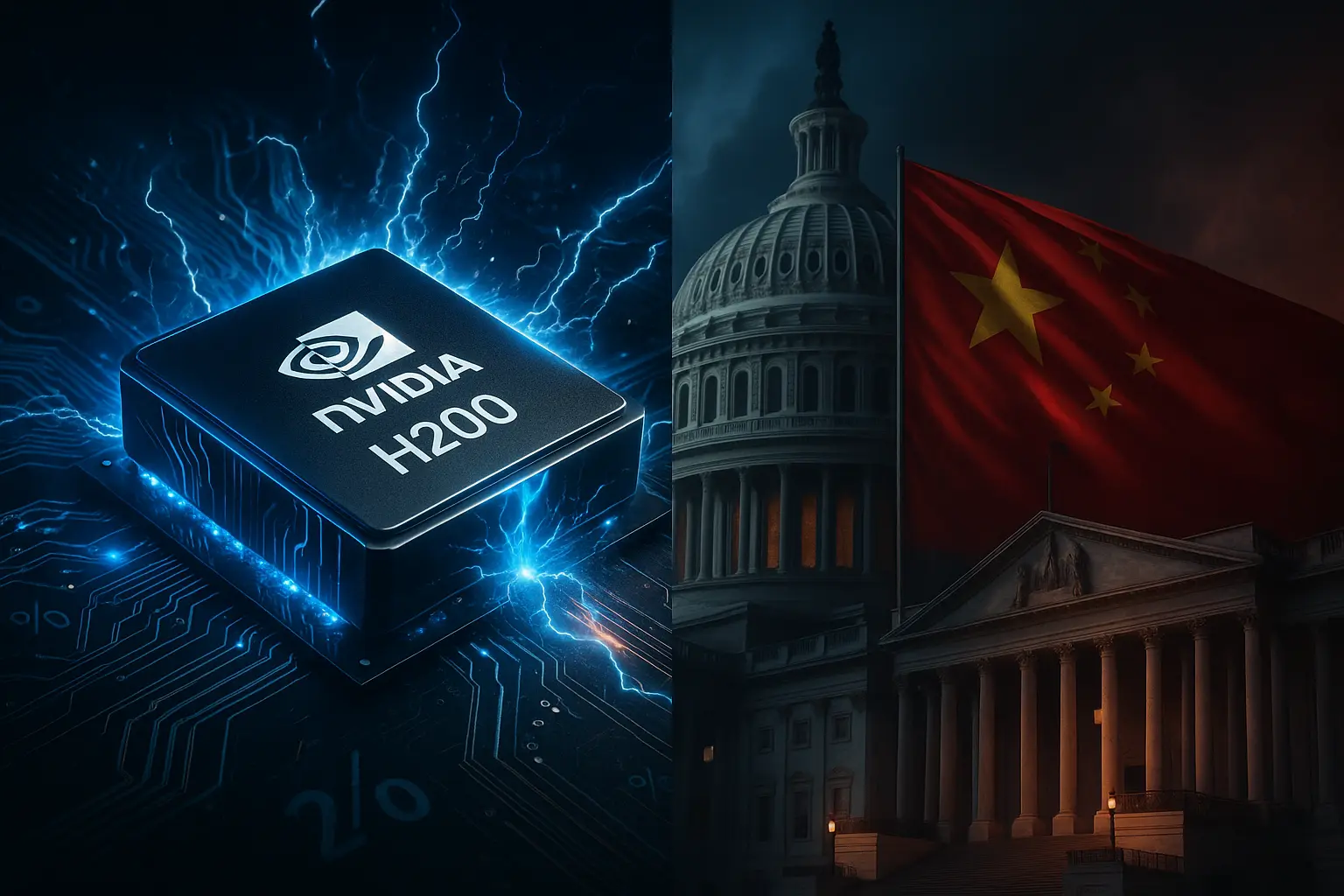
- President Donald Trump says Nvidia can sell its more advanced H200 AI chip to China.
- Analysts warn the move could meaningfully accelerate China’s AI capabilities.
- Beijing continues pushing for tech self-reliance and reducing foreign dependence.
BEIJING — President Donald Trump’s surprise decision to let Nvidia ship a more powerful artificial intelligence chip to China is raising alarms among analysts who say the move could dramatically boost Beijing’s tech capabilities.
The policy shift marks a sharp turn from years of tightening U.S. semiconductor restrictions. While the curbs were designed to slow China’s access to cutting-edge computing, Chinese firms like DeepSeek have still managed to build competitive AI models—often at lower operating costs than their U.S. rivals.
“Compute is our main advantage,” said Rush Doshi, assistant professor at Georgetown University, in a post on X. He noted that China already holds strengths in areas like electrical power and engineering talent.
“By giving this up, we increase the odds the world runs on Chinese AI,” added Doshi, who previously served on the National Security Council under the Biden administration.
A 25% U.S. Cut — and a Major Concession for China
On Monday, Trump posted on Truth Social that Nvidia will be allowed to ship the advanced H200 chip to “approved customers in China” and certain other countries — but only if the U.S. government receives a 25% cut of revenue.
That’s a jump from the 15% rate negotiated earlier this year.
Trump emphasized that Nvidia’s top-tier Blackwell and Rubin chips are still excluded from the China deal.
He also criticized the previous administration, saying the U.S. forced companies to spend “BILLIONS OF DOLLARS” creating weaker, “degraded” chips that “nobody wanted.”
Nvidia had developed a lower-performance H20 model to comply with U.S. rules, but stopped shipments to China in April.
Analysts: China Just Got a Major AI Boost
“This move is giving China a bunch of advanced AI computing it wouldn’t otherwise have,” said Tim Fist, director of emerging technology at the Institute for Progress.
First outlined what he called China’s fast-forming AI stack:
Nvidia chips + Tencent/Baidu/Alibaba cloud + DeepSeek/Qwen/Kimi models.
That combination, he warned, will increasingly compete with U.S. tech abroad.
A new report from the think tank estimated that America’s computing advantage over China in 2026 could shrink from roughly 10x to just 5x if H200 exports proceed.
The H200 chip is expected to give Chinese AI developers a meaningful performance boost, making it “far more useful and effective” than the toned-down H20, said George Chen, partner and co-chair of digital practice at The Asia Group.
Chen also noted that the decision hints at warming U.S.–China relations ahead of Trump’s planned visit to Beijing in April. But he pointed out that Nvidia’s sales window for the H200 “won’t be forever.”
China Still Pushing for Complete Tech Self-Reliance
Even with renewed access to Nvidia chips, Beijing has been aggressively working to cut its dependency on U.S. technology.
China’s upcoming five-year plan directs even more government funding toward domestic chip manufacturing and AI applications.
Huawei, for its part, recently unveiled multi-year plans to develop chips capable of delivering the world’s highest computing power when scaled in clusters.
“China will continue to do everything in its power to reduce its dependency on US AI chips,” said Chris McGuire of the Council on Foreign Relations.
He noted, however, that China doesn’t expect to build a chip surpassing the H200 until at least late 2027.
McGuire said Trump’s move “negates the biggest U.S. advantage over China in AI” and called it “a significant strategic mistake.”
The White House Office of Science and Technology Policy did not respond to a request for comment.
Nvidia’s Position Strengthens — Even as the U.S. Cracks Down
Nvidia CEO Jensen Huang has repeatedly acknowledged China’s advancing AI capabilities and urged U.S. leaders to allow continued chip sales to the country.
Still, Washington is trying to stay firm on export enforcement.
On Monday, the Department of Justice announced it seized over $50 million worth of advanced GPUs intended for China and other restricted regions.
Officials said individuals had “exported and attempted to export” at least $160 million in Nvidia H100 and H200 chips between October 2024 and May 2025.
Nvidia shares rose about 2% in after-hours trading following Trump’s announcement.
In China, AI chipmakers Moore Threads gained over 2%, Cambricon rose more than 1%, while SMIC dropped more than 2% in Hong Kong.