Key Points
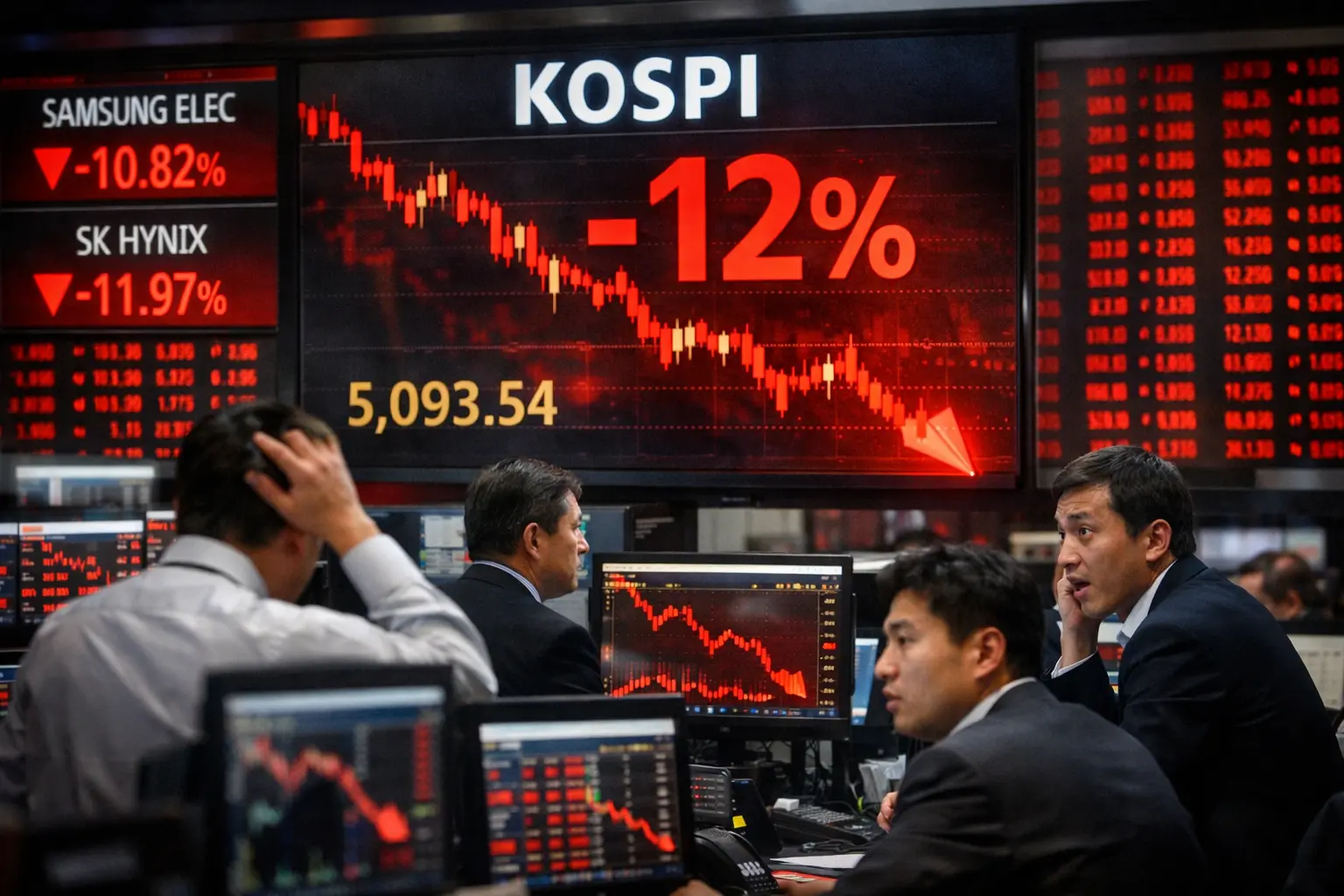
- South Korea’s Kospi index plunged more than 12% on Wednesday, marking its worst single-day drop on record.
- The market had been on a massive rally last year, surging over 75%, and continued rising into early this year.
- Escalating tensions in the Middle East and rising oil prices rattled investor sentiment across global markets.
South Korea’s stock market suffered a dramatic collapse on Wednesday, with the Kospi index posting its worst single-day decline ever as geopolitical tensions and a wider sell-off across Asian markets shook investor nerves.
The benchmark Kospi tumbled 12.1% to close at 5,093.54, extending sharp losses from the previous session. The sudden drop forced the Korea Exchange to temporarily halt trading during the day. Meanwhile, the tech-heavy Kosdaq index also triggered a circuit breaker and ended the session down 14% at 978.44.
Heavyweight tech stocks led the plunge. Samsung Electronics dropped nearly 12%, while SK Hynix fell about 10%, dragging the broader market sharply lower.
A Market That Had Been Soaring
The dramatic sell-off comes after an incredible rally for South Korean stocks. In 2025, the Kospi surged more than 75%, driven largely by a boom in semiconductor companies.
That momentum continued into the new year, pushing the index to fresh highs as global demand for memory chips used in artificial intelligence data centers fueled strong gains for tech giants like Samsung and SK Hynix.
But that same concentration in a few major companies may now be amplifying the market’s decline.
“The drop in the KOSPI can largely be explained by the heavy concentration of individual stocks in the index,” said Lorraine Tan, Asia director of equity research at Morningstar.
According to Morningstar data, Samsung Electronics and SK Hynix alone make up nearly 50% of the Kospi index.
Tan said part of the decline reflects profit-taking after a huge rally, combined with a broader “risk-off” mood in global markets.
She also noted growing concerns that the rapid expansion of AI data centers could slow down, partly because they require significantly more energy than traditional facilities.
Oil Prices and Geopolitics Add Pressure
Another key factor weighing on South Korean markets is rising oil prices tied to escalating conflict in the Middle East.
Daniel Yoo, global market strategist at Yuanta Securities, said South Korea’s stock market tends to be especially sensitive to oil price swings, making geopolitical tensions a major driver of short-term volatility.
South Korea is a major importer of oil, and its manufacturing-heavy economy can quickly feel the impact of rising energy costs.
When crude prices spike, industrial companies and export-focused businesses often face pressure.
According to Nomura, South Korea’s net oil imports equal about 2.7% of its GDP, making the country particularly vulnerable to external energy shocks.
Yoo said the recent plunge should likely be viewed as a market correction after an extended rally, rather than a fundamental change in the long-term outlook.
“If oil prices stabilize, the market could regain its footing,” he said.
Asian Markets Also Slide
The sell-off wasn’t limited to South Korea. Markets across Asia fell as investors reacted to geopolitical tensions and economic uncertainty.
- Japan’s Nikkei 225 dropped 3.61% to 54,245.54, while the Topix fell 3.67% to 3,633.67.
- Australia’s S&P/ASX 200 declined 1.94% to 8,901.20.
- Hong Kong’s Hang Seng index slipped more than 2%.
- Mainland China’s CSI 300 fell 1.14% to 4,602.62.
- India’s Nifty 50 dropped 1.16%.
Investors are also closely watching China’s major annual political meetings, known as the “Two Sessions.”
The event includes a consultative congress followed by the National People’s Congress, where Chinese Premier Li Qiang is expected to announce new economic targets and policy plans.
China Factory Activity Slows
Adding to market concerns, China released fresh economic data showing factory activity weakened in February.
The country’s official manufacturing purchasing managers’ index (PMI) fell to 49, according to the National Bureau of Statistics. Economists had expected a reading of 49.1.
A PMI reading below 50 signals contraction.
The slowdown was partly linked to factories pausing operations and shipments during an extended holiday period.
Oil Prices Jump as Strait of Hormuz Tensions Rise
Energy markets also reacted strongly to developments in the Middle East.
- U.S. crude futures jumped 2.8% to $76.65 per barrel.
- Brent crude climbed 3.03% to $83.86 per barrel.
The surge came amid reports that Iran attempted to close the Strait of Hormuz, one of the world’s most critical oil shipping routes.
According to Iranian media, a senior commander from Iran’s Revolutionary Guard said the waterway had been shut and warned that vessels attempting to pass through could be targeted.
In response, U.S. President Donald Trump said the U.S. Navy would escort oil tankers through the strait if necessary.
“No matter what, the United States will ensure the free flow of energy to the world,” Trump said in a post on Truth Social.
Precious Metals Rally as Investors Seek Safety
As volatility hit equity markets, investors moved into safe-haven assets.
- Gold rose 1.64% to $5,170 per ounce.
- Silver jumped nearly 3% to $84.49 per ounce.
Wall Street Also Faces Turbulence
U.S. stocks also experienced a volatile trading session overnight amid concerns about a prolonged U.S.–Iran conflict.
- The Dow Jones Industrial Average fell 403.51 points (0.83%) to 48,501.27.
- The S&P 500 dropped 0.94% to 6,816.63.
- The Nasdaq Composite declined 1.02% to 22,516.69.
At their lowest levels during the day, the S&P 500 was down about 2.5%, while the Nasdaq fell roughly 2.7%. The Dow briefly dropped more than 1,200 points before recovering some losses.
Hot Inflation Shock Sends Stocks Sliding — AI Fears, Layoffs and Market Stress Rattle Wall Street