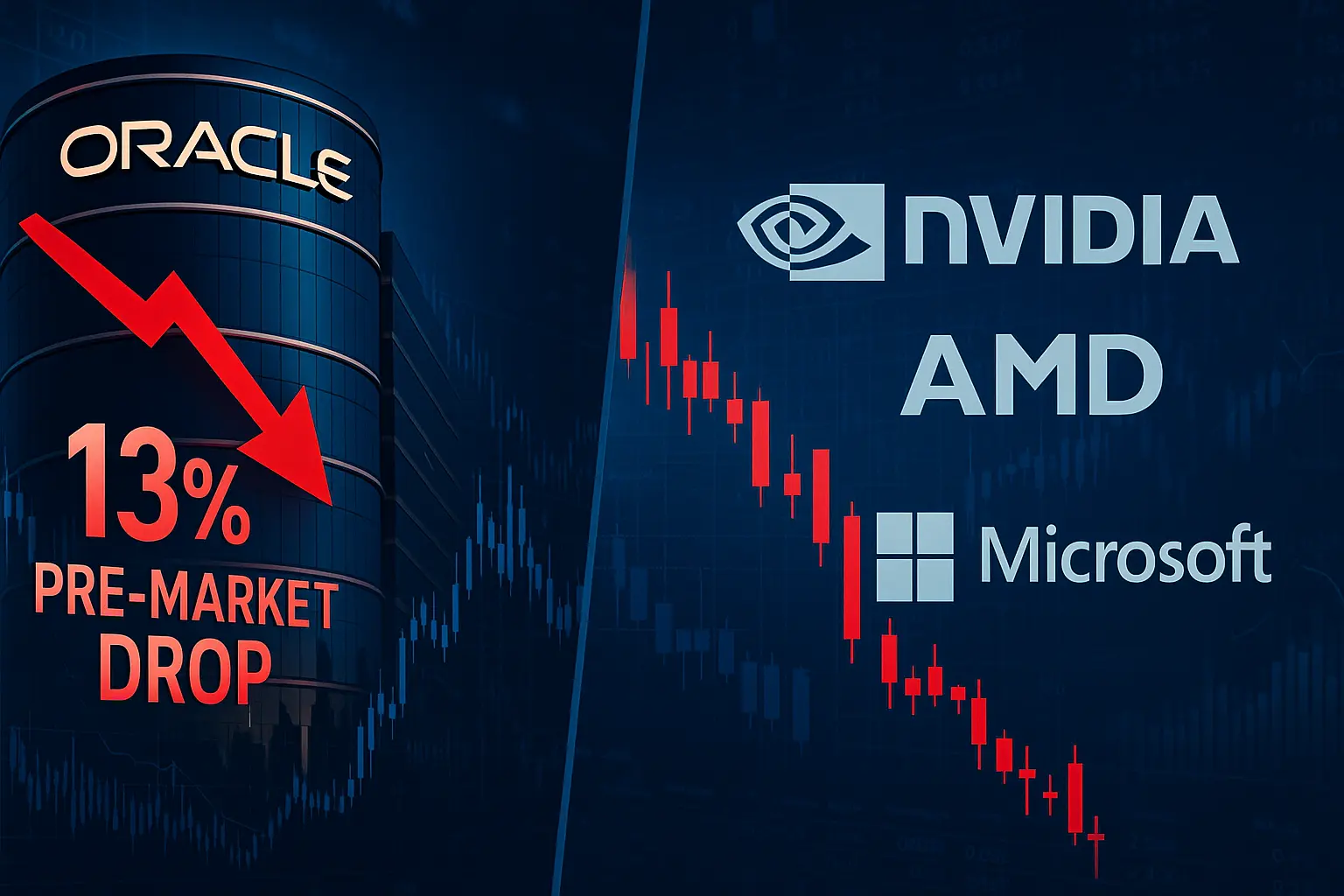
Oracle’s (ORCL) recent pre-market shock served as a warning to investors. The Oracle stock price plummeted by nearly 13% before the opening bell, putting pressure not only on ORCL but also triggering a sharp sell-off in broader AI-related stocks.
The main reason appears to be that the company missed revenue estimates in its recent quarterly report and announced a massive increase in future capital expenditures (capex) – Oracle raised its annual capex target to approximately $50 billion, with about $15 billion earmarked for new data center investments. This significant investment raised concerns among investors regarding profitability and debt burden.
The fact that the recent Oracle earnings report delivered mixed signals also contributed to the negative sentiment: while the company exceeded expectations on some metrics, total revenue fell slightly short of estimates. For example, the report showed total revenue of approximately $16.1 billion, which was close to market expectations but still missed the mark, and this is what negatively impacted the ORCL stock price in pre-market trading.
In its earnings call and presentation, Oracle outlined its plans for significant investments in AI and cloud infrastructure. The company argued that massive data center capacity is necessary to support AI services, but investors were wary of the rapidly increasing capex and the associated financial challenges – the impact of which was clearly visible on Oracle stock and related sectors (such as AI infrastructure suppliers).
Oracle Dip — What It Means for the Market (ORCL)
The impact of this decline was not limited to Oracle alone. Shares of other major players and companies involved in AI infrastructure also saw declines of several percentage points as the market began to consider that if a company like Oracle is facing cost pressures, other companies’ margins might also be affected. Several market analysts, including Barron’s, noted that Nvidia and other AI chip/cloud-exposed stocks also came under pressure. From an investor’s perspective, this could also be a buying opportunity. Investors who believe in long-term AI demand might see this temporary dip as a chance to buy, while those who employ metrics-based risk management might consider reducing short-term risk. Therefore, the appropriate response to the Oracle stock movement will depend on your investment horizon. (Ticker: ORCL)
Is this a sign that the AI bubble is bursting? Some analysts are warning that overvaluation and the race to build infrastructure with significant debt carry potential risks; however, many other analysts believe that real demand remains strong and that companies can generate long-term revenue through cutting-edge software and cloud services. This market movement, therefore, likely reflects more immediate uncertainty rather than the imminent demise of the entire sector.
Practical tips for investors (in brief):
- If Oracle stock makes up a significant portion of your portfolio, conduct a risk assessment.
- If you are a long-term investor and believe in the demand for AI, this dip could present an opportunity – but first, examine the company’s cash flow, capex plans, and debt structure.
- Short-term trader sentiment changes rapidly; therefore, use stop-losses or proper position sizing.
In conclusion, today’s pre-market decline has certainly tarnished Oracle’s stock, but it also serves as a reminder that the rapidly increasing investment in AI infrastructure comes with both opportunities and risks. Readers and investors should consider Oracle’s earnings, the company’s capital expenditure plans, and overall market sentiment before making any investment decisions. (Always consult with your financial advisor before making any investment.)