Key Points
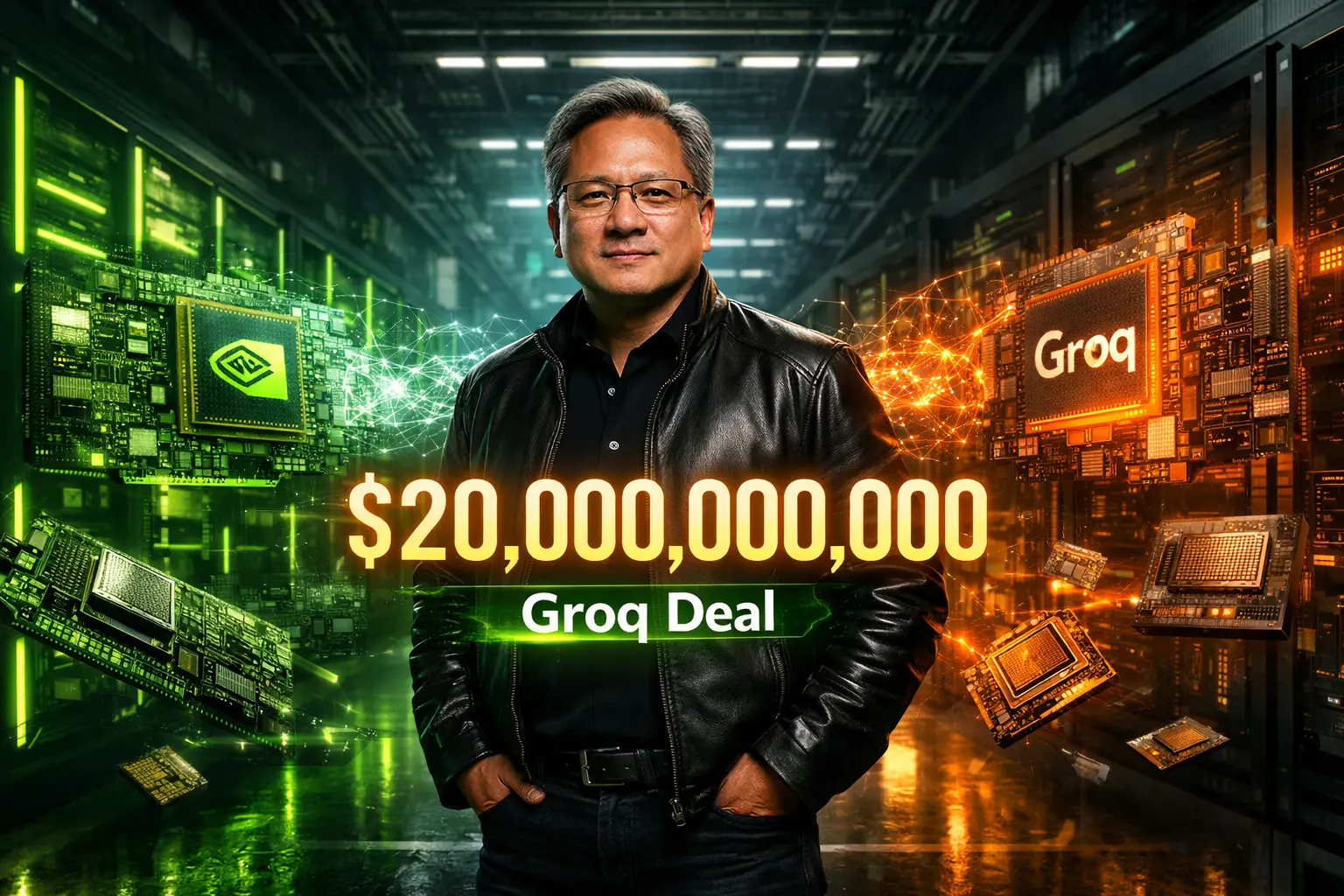
- Nvidia is making its biggest purchase ever, agreeing to buy assets from AI chip startup Groq in a deal valued at around $20 billion
- Groq was founded by the creators of Google’s TPU chips — the same tech that competes directly with Nvidia in AI workloads
- Groq says this is a “non-exclusive licensing agreement,” and its CEO and senior leaders will join Nvidia
Nvidia is doubling down on AI dominance — and it’s writing one of the biggest checks in chip history to do it.
The company has agreed to buy key assets from Groq, a fast-rising designer of high-performance AI accelerator chips, in a deal worth $20 billion in cash, according to Alex Davis, CEO of investment firm Disruptive, which led Groq’s fundraising round just a few months ago.
Davis, whose firm has invested more than $500 million in Groq since its founding in 2016, said the deal came together incredibly quickly. Groq only raised $750 million in September at a $6.9 billion valuation, attracting big-name backers including BlackRock, Neuberger Berman, Samsung, Cisco, Altimeter, and 1789 Capital, where Donald Trump Jr. is a partner.
Groq publicly framed the move a bit differently. In a blog post, the company stated that it has “entered into a non-exclusive licensing agreement with Nvidia for Groq’s inference technology,” without disclosing the terms or price. Groq founder and CEO Jonathan Ross, company president Sunny Madra, and several senior executives will join Nvidia to help scale the technology.
However, Groq insists it’s not disappearing. The startup says it will continue as an “independent company,” with CFO Simon Edwards taking over as CEO.
Nvidia’s CFO Colette Kress declined to comment. But behind the scenes, Davis told CNBC that Nvidia is essentially getting all of Groq’s assets, except for the company’s still-growing GroqCloud platform — which Groq says will keep running without interruption.
Nvidia’s Biggest Deal Ever
This is the largest purchase Nvidia has ever made — by far.
Previously, Nvidia’s biggest acquisition was its $7 billion Mellanox purchase in 2019. Now, with more than $60.6 billion in cash and short-term investments sitting on its books as of October (up from just $13.3 billion in early 2023), Nvidia clearly has no problem spending.
In an internal email obtained by CNBC, Nvidia CEO Jensen Huang said the agreement significantly boosts Nvidia’s AI muscle.
“We plan to integrate Groq’s low-latency processors into the NVIDIA AI factory architecture, extending the platform to serve an even broader range of AI inference and real-time workloads,”
Huang wrote.
He emphasized one key point:
Nvidia is not buying Groq, the company — it’s licensing its IP and absorbing top talent.
This move mirrors another Nvidia play from September, when it spent over $900 million to hire leadership from AI hardware startup Enfabrica and license its technology.
The AI Talent War Is Getting Fierce
Nvidia isn’t the only one aggressively scooping up AI expertise. Meta, Google, and Microsoft have also been spending big to secure elite AI engineers and tech through similar licensing deals.
Meanwhile, Nvidia has been spreading its investment power across the AI ecosystem, backing energy and AI infrastructure firm Crusoe, AI model builder Cohere, and boosting funding in cloud provider CoreWeave, which is racing toward a public listing.
The chip giant also announced plans to invest up to $100 billion in OpenAI, with OpenAI committing to deploy massive Nvidia computing power — though no final deal has been formally announced yet. Nvidia also agreed to invest $5 billion in Intel as part of a broader partnership.
Why Groq Mattered So Much
Groq has quickly become one of the hottest names in AI hardware, targeting $500 million in revenue this year thanks to exploding demand for AI accelerator chips that power inference tasks in large language models.
The company wasn’t actually shopping itself when Nvidia came calling, according to Davis.
Founded in 2016 by a group of former Google engineers, including Ross, Groq built on expertise from Google’s TPU (tensor processing unit) — the custom AI chip technology that competes directly with Nvidia GPUs.
Groq has attracted intense industry buzz, even filing early SEC documents in 2016 listing Ross and former Google X engineer Douglas Wightman among its leaders. Wightman left the company in 2019.
They aren’t alone in the race. AI chipmaker Cerebras Systems also surged during the AI boom, even preparing to go public before pausing its IPO plans last October. The company still hopes to list in the future.
The Bottom Line
Nvidia’s move is bold, expensive, and strategic. It strengthens its grip on AI computing, scoops up world-class chip talent, and extends the company’s influence deeper into real-time AI processing.
For Groq, this is a massive validation moment. For Nvidia, it’s another aggressive step toward securing its position as the undisputed powerhouse of the AI era.
And for the rest of Silicon Valley?
The AI chip arms race just went nuclear.