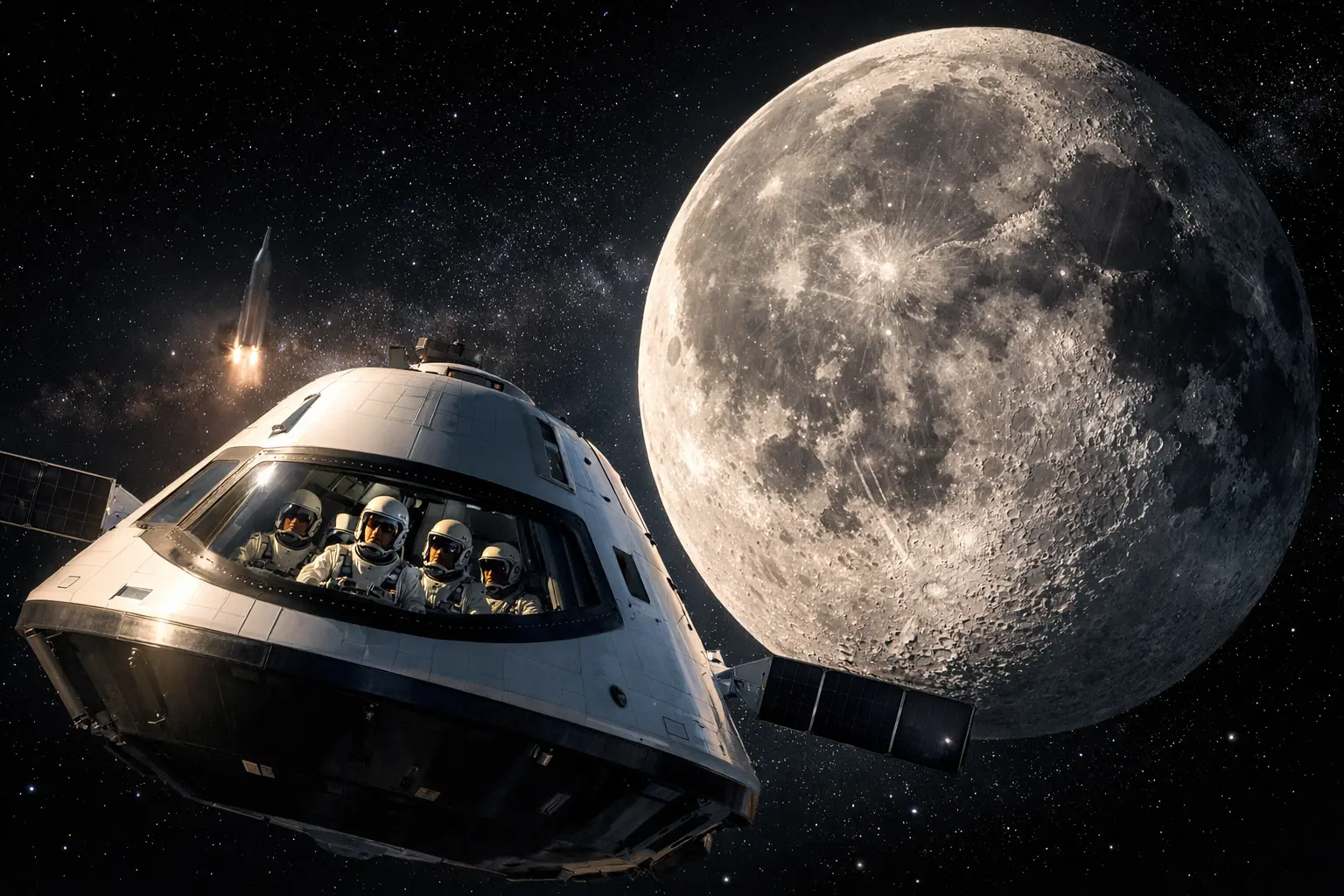
NASA is gearing up for a historic return to deep space with Artemis II, the first crewed lunar mission in more than five decades. The agency’s massive Space Launch System (SLS) rocket and Orion spacecraft are set to roll out to the launch pad this week at Kennedy Space Center in Florida — a major milestone as liftoff looms as early as Feb. 6, 2026.
Unlike missions that orbit Earth, Artemis II will carry four astronauts on a 10-day journey around the Moon and back, a feat not attempted since NASA’s Apollo program in the early 1970s. But despite all the buzz, this mission won’t land on the lunar surface.
🚀 Rolling Toward Launch
This weekend marks a pivotal moment: NASA’s 322-foot SLS rocket — one of the most powerful ever built — will be transported from the Vehicle Assembly Building to Launch Complex-39B, a roughly four-mile trek that could take up to 12 hours. Once in place, engineers will run through final prelaunch tests, including a “wet dress rehearsal” where the rocket is fueled, and countdown procedures are practiced.
The rollout and tests set the stage for liftoff opportunities spanning from early February through mid-April, contingent upon weather, technical readiness, and other range constraints.
👩🚀 The Crew Heading Into Deep Space
A quartet of astronauts will make the trip:
- Reid Wiseman – Commander
- Victor Glover – Pilot
- Christina Koch – Mission specialist
- Jeremy Hansen – Mission specialist (Canadian Space Agency)
This group is notable not just for where they’re going, but who’s going: Koch will be among the first women to travel beyond Earth orbit, and Hansen will be the first Canadian to join a lunar-bound crew.
🌑 What the Mission Will (and Won’t) Do
Once launched, Artemis II won’t touch down on the Moon — or even enter lunar orbit. Instead, the Orion capsule will loop around the Moon at a distance of tens of thousands of miles, using the Moon’s gravity to arc back toward Earth.
Over about 10 days, the crew will test critical systems like life support, navigation, and communications in deep space — vital practice runs for future missions that will aim for a lunar landing. NASA officials have stressed that proving Orion works safely with humans aboard is the mission’s top priority.
🌍 Why This Matters
Artemis II is more than a tribute to the Apollo era. It’s the first step in NASA’s Artemis campaign, a long-range plan to build a sustainable human presence on and around the Moon — and eventually push humans on to Mars.
Though a landing isn’t scheduled until Artemis III (potentially as soon as 2027), Artemis II is widely seen as the critical test that must succeed first — ensuring hardware, software, and human crews can handle the rigors of deep-space travel.