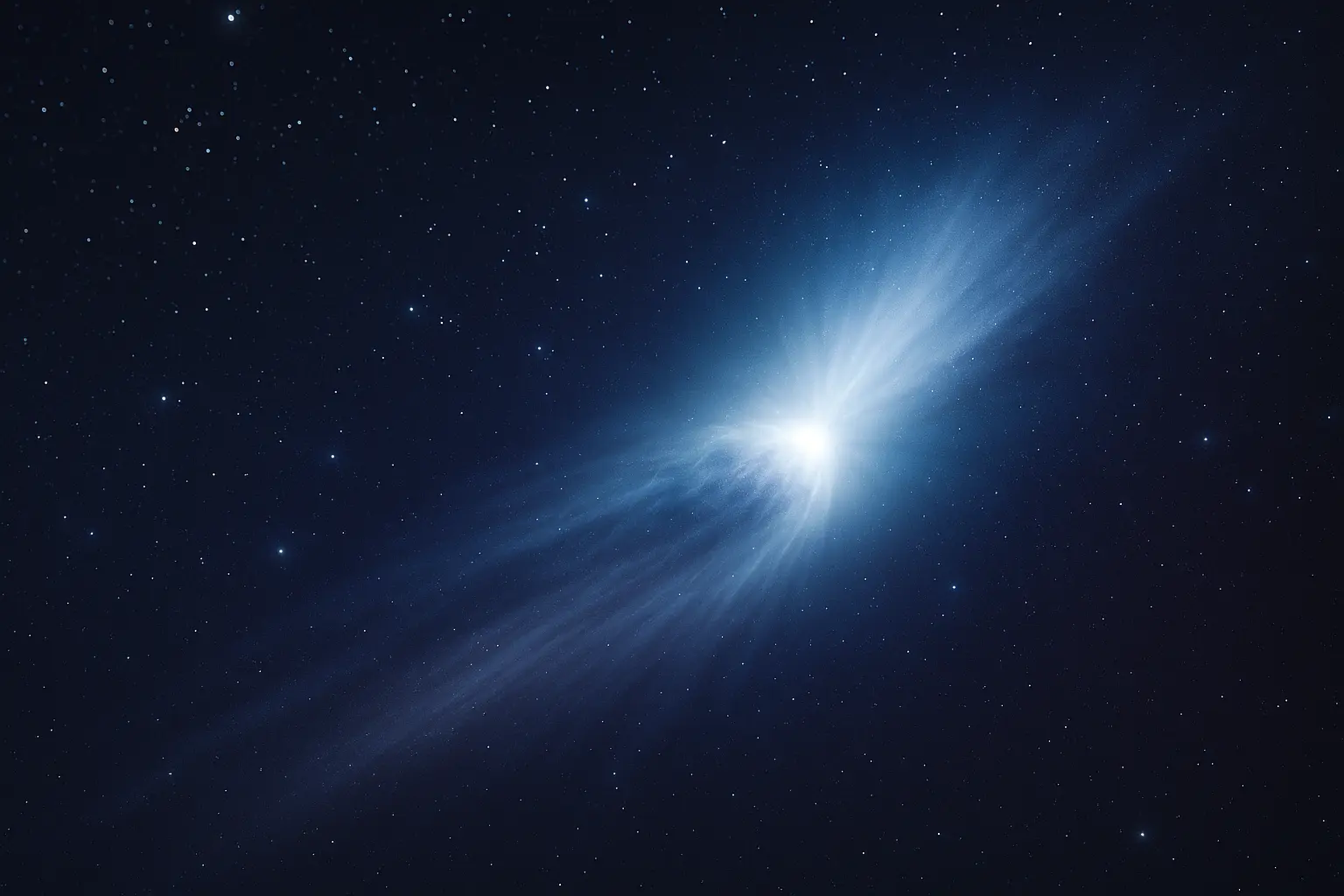
The famous interstellar comet 3I/ATLAS is making its final exit from our solar system — but not before Earth’s “cosmic paparazzi” capture some of the sharpest images we’ve ever seen of it.
First spotted in late June and officially confirmed in July as only the third known interstellar visitor, 3I/ATLAS has been racing through the inner solar system at nearly 130,000 mph (210,000 km/h). The icy, jet-like fireball made close passes by Mars and the sun in October. Now it’s headed for its nearest approach to Earth on Dec. 19, when it will still be a distant 170 million miles (270 million km) away — almost twice the Earth-sun distance.
As the comet speeds toward this milestone, spacecraft operated by NASA and the European Space Agency (ESA) are scrambling to collect every possible close-up. And this week, both agencies released new images proving that its recent brush with the sun has made the comet incredibly bright and active, blasting out huge amounts of gas and dust.
Hubble Takes Another Shot
On December 4, NASA unveiled a new image of 3I/ATLAS, captured by the Hubble Space Telescope. At the center of the frame is a glowing white core — the comet’s nucleus and coma, the bright cloud of gas and dust that surrounds it before streaming outward into a long tail. Behind it, the background stars appear stretched, thanks to Hubble tracking the comet’s rapid motion.
Comets naturally brighten as they near the sun, where intense heat causes ice to sublimate and form a tail pushed outward by solar radiation. Sometimes the sun-facing side erupts with powerful jets of gas and dust. Both effects are visible in Hubble’s latest view.
Hubble snapped this image on Nov. 30 from about 178 million miles (286 million km) away — far closer than its first attempt in late July. That initial blurry blue blob still helped scientists estimate the comet’s size to be between 1,400 feet (440 meters) and 3.5 miles (5.6 km) wide, which likely makes 3I/ATLAS the largest interstellar object ever observed.
NASA hasn’t yet released the new data on the coma’s composition, but more details are expected soon.
ESA’s JUICE Spacecraft Joins In
On the same day, ESA published its own latest snapshot of the comet — this one taken by the Jupiter Icy Moons Explorer (JUICE) as it heads toward Jupiter to hunt for signs of life.
JUICE captured its image on Nov. 2, just days after 3I/ATLAS swung past the sun. At only 41 million miles (66 million km) from the comet, the spacecraft got an even more vivid view than Hubble.
ESA says the image clearly shows a bright halo of gas forming the coma — and even hints at two separate tails:
- A plasma tail made of charged particles stretching upward
- A fainter dust tail drifting down and to the left
JUICE observed the comet using five instruments over two days. But most of the data won’t reach Earth until late February 2026. The spacecraft is currently using its main antenna as a heat shield for its close pass by the sun, so it’s relying on a weaker backup antenna to send information home.
More Spacecraft Are Watching — And Earth Is Next
Hubble and JUICE are just two observers in a huge cosmic crowd. NASA says at least a dozen spacecraft have been tracking 3I/ATLAS, including:
- Mars rovers
- Solar-orbiting spacecraft
- Asteroid-hunting probes
- Multiple space telescopes
Many of these missions were never designed to study comets — yet this rare interstellar visitor offers a unique chance to push their limits.
And the best may still be ahead. As 3I/ATLAS moves closer to Earth, the James Webb Space Telescope is preparing to take another look. Ground-based observatories, university researchers, and amateur astronomers will join in, too.
When an object from outside our solar system swings by — mysterious, massive, and moving fast — every observation counts.