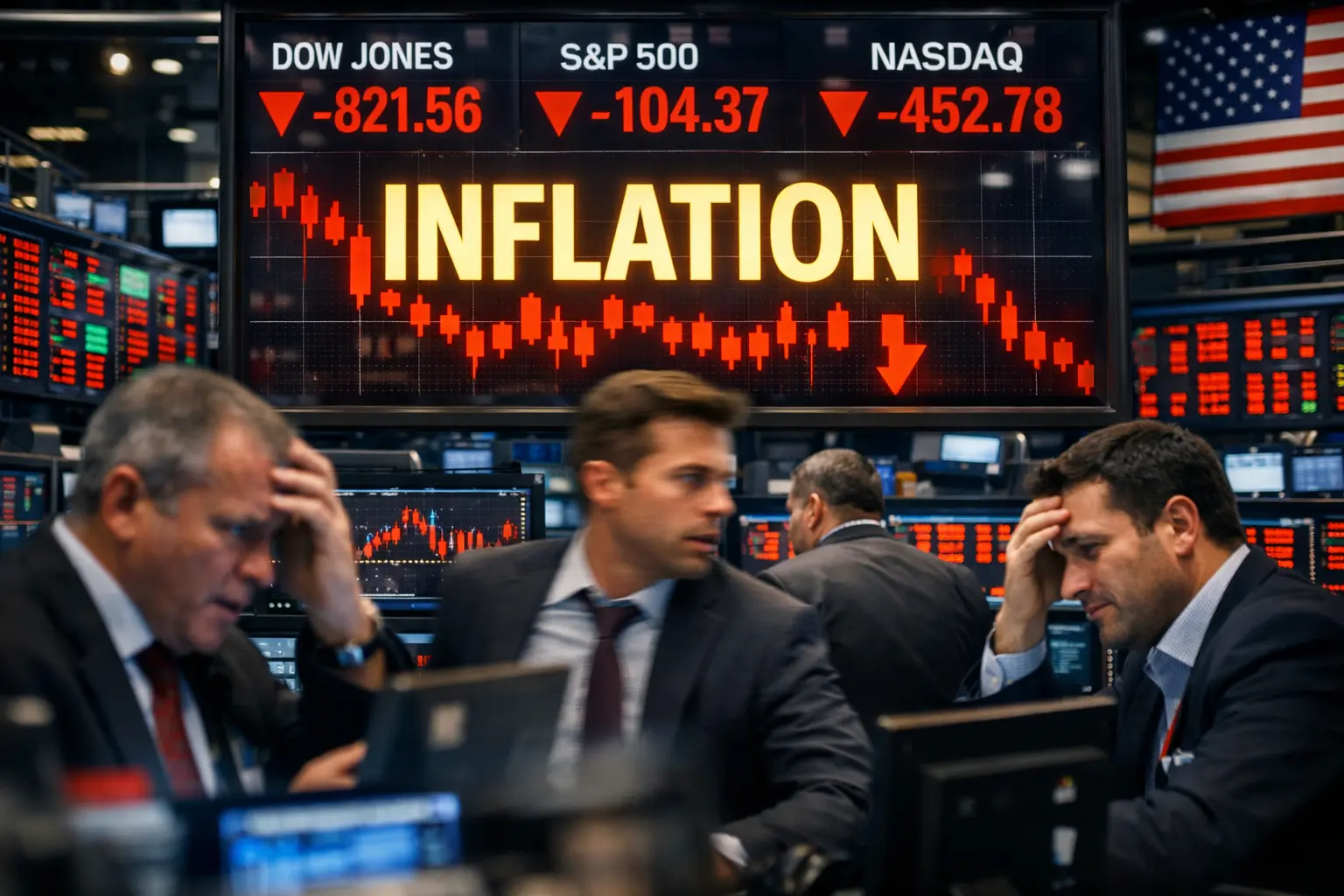
Stocks fell sharply on Friday after a hotter-than-expected inflation report added fresh pressure to an already uneasy market, deepening investor concerns about artificial intelligence spending, layoffs, and stress in parts of the financial system.
The Dow Jones Industrial Average dropped 521.28 points, or 1.05%, closing at 48,977.92. The S&P 500 slipped 0.43% to 6,878.88, while the Nasdaq Composite lost 0.92% to finish at 22,668.21.
Both the S&P 500 and Nasdaq ended February in negative territory as worries mounted over how AI could reshape industries and the broader economy. Those concerns intensified after fintech firm Block, led by Jack Dorsey, announced plans to lay off more than 4,000 employees — nearly half its workforce. Financial stocks and other economically sensitive sectors moved lower during Friday’s session.
Inflation Surprise Adds Fuel to Market Anxiety
Investor sentiment weakened after January’s producer price index (PPI), a key measure of wholesale inflation, rose 0.5% for the month, well above economists’ expectations of a 0.3% increase.
Even more troubling for markets, core PPI, which excludes food and energy prices, jumped 0.8%, far exceeding forecasts for a 0.3% gain.
Stephen Kolano, chief investment officer at Integrated Partners, said the report adds another layer of uncertainty for investors already grappling with concerns about AI spending and stress in private credit markets.
He noted that inflation appears increasingly driven by services, suggesting companies may be passing tariff-related costs on to consumers to protect profit margins.
“Inflation isn’t solved yet,” Kolano said, adding that the Federal Reserve now faces a difficult decision between cutting interest rates to support growth or keeping policy tight to fight inflation. “It creates uncertainty around where policy goes for the rest of the year.”
Kolano also flagged the labor market as a growing concern. While recent job growth exceeded expectations, layoffs have been rising. Challenger, Gray & Christmas reported that January layoffs reached their highest level for that month since the global financial crisis.
“I don’t see a clear sign that unemployment isn’t going to move higher,” he said.
Private Credit Fears Hit Financial Stocks
Stocks tied to private credit came under renewed pressure after investors worried about fallout from the collapse of UK mortgage provider Market Financial Solutions.
Apollo and Jefferies were among the biggest losers, falling more than 8% and 9%, respectively. Shares of Blue Owl dropped roughly 6% amid ongoing concerns tied to liquidity restrictions and asset sales.
Banks and financial firms broadly declined as investors reassessed risks linked to private financial markets exposure.
Tech and Software Stocks Struggle to End Tough Month
Technology shares continued to weigh on markets as February closed.
Salesforce and Microsoft each fell more than 2%, dragging on the Dow. Cybersecurity firm Zscaler plunged 12% after reporting weaker-than-expected deferred revenue and billings for its fiscal second quarter. AI cloud provider CoreWeave slid 18% following disappointing guidance.
Nvidia extended its post-earnings decline, dropping another 4% Friday after losing more than 5% the previous day. Despite strong quarterly results, investors cited concerns about the company’s deal with OpenAI, weakening enthusiasm around AI trades, and doubts about whether massive AI spending by hyperscale companies can continue at current levels.
February Ends on a Weak Note for Tech
The Nasdaq fell more than 3% for the month, marking its worst performance since last March. The iShares Expanded Tech-Software ETF (IGV) dropped nearly 10% in February, pushing its year-to-date losses close to 23%.
Meanwhile, the S&P 500 lost nearly 1% during the month, while the Dow managed a modest gain of about 0.2%.
Mixed Signals From Corporate America
Despite market volatility, several companies delivered notable developments:
- CoreWeave shares plunged about 20% after weak first-quarter guidance, though analysts remained divided on the company’s long-term AI potential.
- Dell Technologies surged more than 21% after beating earnings expectations and forecasting strong growth driven by AI server demand, which is expected to more than double by fiscal 2027.
- Analysts generally maintained bullish ratings on Dell, though some warned that AI-driven memory shortages could pressure margins and demand.
- Corporate buybacks surged in February, with U.S. companies authorizing $233.3 billion in repurchases — the largest February on record, according to Birinyi Associates.
Major buyback announcements came from Salesforce ($50 billion), Walmart ($30 billion), Verizon ($25 billion), along with PepsiCo, AT&T, and Dell.
Defensive Stocks Offer Some Stability
Not all sectors declined. Defensive areas of the market helped limit broader losses.
Consumer staples, including Walmart, Costco, Coca-Cola, Procter & Gamble, and PepsiCo, posted gains. Energy companies ExxonMobil and Chevron also moved higher, along with pharmaceutical firms such as Merck, AbbVie, and Amgen.
Utilities stocks advanced as investors rotated toward safer assets amid rising uncertainty.
Other Market Movers
- Netflix shares jumped after walking away from a bidding war for Warner Bros. Discovery assets, allowing investors to refocus on its core business.
- Duolingo fell 14% after issuing weaker-than-expected revenue guidance.
- Monster Beverage impressed Wall Street with strong quarterly results, prompting multiple analysts to raise price targets.
- Trump Media & Technology Group said it is considering spinning off Truth Social into a separately traded company.
Meanwhile, Wall Street’s fear gauge — the CBOE Volatility Index (VIX) — climbed above 20, signaling rising investor anxiety.
European Stocks Slip as Global Tensions Hit Markets and Davos Takes Center Stage
Technical Pressure Builds
The S&P 500 slipped below its closely watched 50-day moving average and fell under a key Fibonacci retracement level, technical signals that could point to further downside if weakness continues.
Adding to caution, UBS downgraded U.S. equities to “benchmark,” citing risks from a weaker dollar, elevated valuations, and policy uncertainty in Washington.
The Bigger Picture
With inflation proving stubborn, layoffs increasing, and AI investment questions emerging, investors are facing a complicated outlook heading into the rest of the year.
Markets now must balance slowing economic momentum against still-elevated inflation — a combination that leaves the Federal Reserve’s next move unclear and keeps volatility firmly in focus on Wall Street.