In a dramatic escalation of foreign policy, former President Donald Trump announced steep tariffs on key European NATO allies as leverage in his ongoing push to acquire Greenland — a semiautonomous Danish territory in the Arctic that both Denmark and Greenland staunchly reject selling.
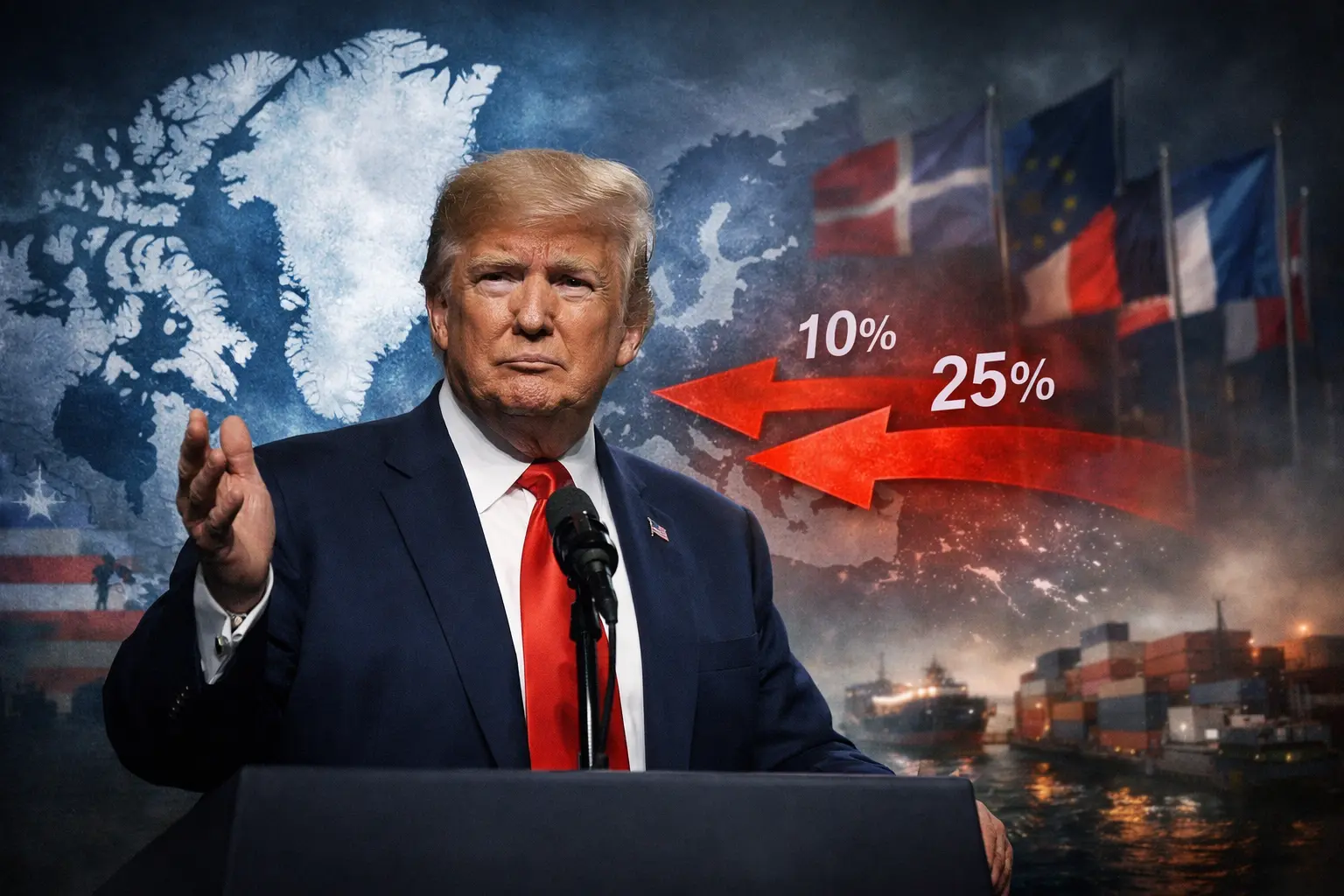
Trump revealed that eight European countries — Denmark, Norway, Sweden, France, Germany, the United Kingdom, the Netherlands, and Finland — will face a 10% tariff on exports to the U.S. starting Feb. 1, 2026, unless a deal is struck for the “complete and total purchase” of Greenland. Those tariffs are set to rise to 25% on June 1 if no agreement is reached.
The tariffs targeting traditional U.S. allies have ignited fierce criticism in Europe and Washington alike, undermining unity within NATO and rattling transatlantic relations.
Tariffs and Tough Talk
Trump framed the tariffs as essential to national security, arguing that U.S. control over Greenland is needed to counter potential Russian and Chinese influence in the Arctic — a stance few foreign policy experts support.
In a Truth Social post, he described the levies as a form of economic leverage until Greenland’s status changes — though both Greenland and Denmark have repeatedly said the island isn’t for sale.
Allies Push Back Hard
European leaders responded with rare unity. A joint statement from the eight affected governments condemned the tariff threats, warning they could unleash a “dangerous downward spiral” in international relations and damage long-standing alliances.
French President Emmanuel Macron called the U.S. threats “unacceptable,” and the European Commission warned the tariffs jeopardize decades of cooperation.
In London, Prime Minister Keir Starmer directly told Trump that penalizing NATO allies for pursuing collective security — like deploying forces to Greenland — was “wrong.”
Grassroots Resistance and Diplomatic Strains
The tariff dispute has spilled into the streets, with large “Hands off Greenland” protests erupting across Copenhagen and Nuuk, where Greenland’s leadership insists its future belongs to its people.
Back in Europe, leaders are preparing emergency talks to coordinate an economic and diplomatic response. Some officials have even floated retaliatory trade measures and safeguards through the EU’s anti-coercion tools.
U.S. Lawmakers and NATO at Odds
Trump’s rhetoric has drawn pushback from politicians on both sides of the aisle in Washington. A bipartisan delegation of U.S. lawmakers traveled to Denmark to reassure Nordic leaders of continued American support, rejecting any notion that Greenland should become U.S. territory by force or coercion.
Several U.S. senators have openly questioned Trump’s strategy, calling the tariff threats a misstep that could weaken NATO’s collective defense framework.
Far-Reaching Consequences
Analysts warn that the dispute could slow broader trade negotiations between the U.S. and the EU and inject uncertainty into global markets as tensions rise between close allies.
With Europe digging in and Greenland resolute in its sovereignty, the standoff marks a rare and risky rupture in transatlantic relations — one that could reshape geopolitical dynamics in the Arctic and beyond.