Key Points
- Tech giants, including Meta, Google, xAI, OpenAI, Microsoft, and Amazon, are racing to build massive AI campuses across the U.S. heartland, turning farmland and factory shells into giant computing hubs that use city-level amounts of power.
- Much of this boom is being funded through record levels of borrowing, and credit markets are starting to flash warning signs, drawing comparisons to the early 2000s fiber bubble.
- At the center is OpenAI, locked into a complex and risky web of deals with Nvidia, Oracle, AMD, Broadcom, SoftBank, and AWS — a “circular” AI economy that only works as long as demand keeps exploding and power keeps flowing.
West Texas dust blows like a constant reminder of where you are — gritty, hot, relentless. And right in the middle of this harsh landscape, OpenAI CEO Sam Altman is building something enormous: Stargate, a rapidly expanding network of AI data centers powered by partners like Oracle, Nvidia, and SoftBank.
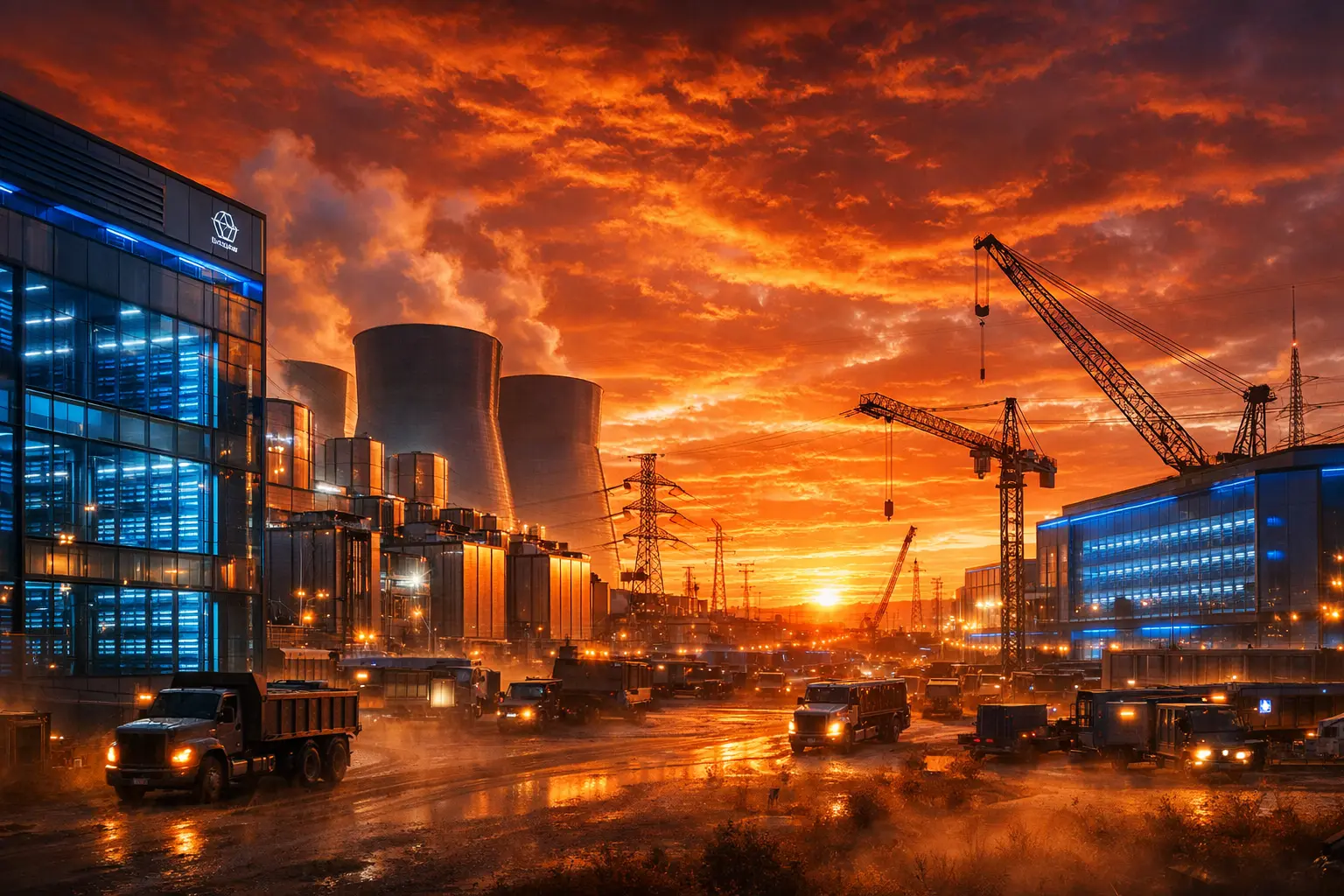
Each morning, around 6,000 workers drive onto a construction site the size of a small city. More people work here than the entire staff of OpenAI. Rain turns everything to mud, then the sun bakes it back into cracked clay. And when evening hits, the sky explodes in red and orange — a dramatic backdrop for what may be the most ambitious tech project in America.
“This is what it takes to deliver AI,” Altman said in September. “Unlike earlier internet revolutions, this one demands massive physical infrastructure. And what you’re seeing here is just a tiny sample.”
A “tiny sample” that costs about $50 billion per site.
OpenAI’s Stargate projects could total $850 billion, almost half of HSBC’s forecasted $2 trillion global AI infrastructure wave. One Abilene data center is already live; another is nearly done. CFO Sarah Friar says the site may exceed 1 gigawatt of power — enough to run 750,000 homes, similar to Seattle and San Francisco combined.
The future AI supply chain is being built now — chips arriving in 2026 and beyond. “There’s a massive compute crunch,” Friar said. Altman added bluntly: “We’d be much bigger already if we had more capacity.”
Land is cheap. States are eager. Power grids can still stretch. And Altman isn’t alone.
The New AI Kingdom Builders
While OpenAI builds in Texas, others are staking their claims:
- Mark Zuckerberg is building Hyperion in Louisiana — a four-million-square-foot AI fortress that will use more electricity than New Orleans and cover land the size of lower Manhattan.
- Google is developing a massive AI campus in Arkansas — the state’s biggest private investment ever.
- Elon Musk built the Colossus supercomputer in 122 days inside an abandoned factory — and he’s already scaling Colossus 2 to 1 million GPUs. He even bought a power plant to feed it.
- Microsoft is investing $7+ billion in Wisconsin for what may become “the world’s most powerful” AI data center.
- Amazon turned Indiana farmland into Project Rainier, an $11 billion site designed exclusively to train AI models for Anthropic.
“Cornfields to data centers, almost overnight,” AWS CEO Matt Garman said.
This isn’t just infrastructure. It’s a bet that intelligence can be manufactured, and the biggest builder wins.
“This is the largest market in human history,” said Bessemer Venture Partners’ Sameer Dholakia. “Bigger than oil — because everyone needs intelligence.”
The Cost: A Debt Wave Wall Street Can’t Ignore
The numbers are staggering.
Hyperscalers like Amazon, Microsoft, Alphabet, and Meta are expected to spend $443 billion in capital expenditures this year, rising to $602 billion by 2026. Roughly 75% of that is AI infrastructure.
But even trillion-dollar companies don’t have that much cash sitting around.
So they borrowed — aggressively.
- $121 billion in new debt this year
- More than 4x the five-year average
- Over $90 billion in just three months
Meta borrowed $30B. Alphabet $25B. Oracle $18B. Analysts expect another $1.5 trillion in tech borrowing ahead.
Credit markets are getting nervous. CDS protection is spiking. Oracle’s debt risk hit multi-year highs. A Meta CDS market just launched because investors wanted insurance.
Wall Street has seen this movie before — during the fiber boom. The tech survived. Many investors didn’t.
OpenAI’s Risky Web of AI Power Deals
At the center of it all sits OpenAI.
In just two months, OpenAI announced roughly $1.4 trillion in partnerships — prompting fears that power, land, and chips simply won’t exist fast enough.
Here’s the rapid-fire deal list:
- $100B equity + supply deal with Nvidia for 10GW of systems
- Partnership with AMD, potentially giving OpenAI a 10% stake
- Broadcom supplying 10GW of custom chips
- First-ever cloud deal with Amazon AWS, easing dependence on Microsoft
The ecosystem is circular:
- Nvidia finances demand for its chips
- Oracle builds data centers
- AMD & Broadcom provide alternatives
- OpenAI commits massive usage
It works beautifully — until it doesn’t. Nvidia has already warned that deals aren’t guaranteed.
Oracle insists demand is real and endless. Anthropic warns that forecasts can swing wildly. Data centers take years to build; demand can change in a quarter.
Meanwhile, OpenAI is preparing to take on significant debt.
“The real bottleneck isn’t money,” Friar said. “It’s power.”
Power Is the New Oil
SoftBank’s Masayoshi Son just paid $4B for DigitalBridge, while committing $40B to OpenAI. To do it, he sold his entire Nvidia stake — something he said made him cry.
Why? Because the most valuable resource now is energized land — sites that can plug into huge amounts of regulated power.
OpenAI even floated CHIPS-Act-style credits for data centers before backlash forced a walk-back. Still, companies aren’t waiting for government help. They’re building now and betting profits come later.
Because if AI truly becomes the everyday operating layer of business, this becomes a utility race — not a tech race.
Will the Boom Pay Off — or Blow Up?
Anthropic revenues have grown 10x year-over-year for three straight years. Its valuation jumped from $60B to potentially $300B in 2025.
Some analysts say contracts are overhyped. Oracle’s stock plunged after expectations deflated. Others say we’re reliving the dot-com overbuild.
But believers argue the upside dwarfs the risk.
“This is the mother of all waves,” said Menlo Ventures’ Matt Murphy.
Anthropic’s Dario Amodei believes AI could operate like “a country of geniuses in a data center” as soon as next year — but warns job disruption could be fast and widespread.
And that fear — combined with ambition — is exactly why the industry is spending like never before.
The Final Question: Breakthrough or Bubble?
Zoom out, and a new American map appears:
- Zuckerberg’s Hyperion
- Musk’s Colossus
- Altman’s Stargate
- Amazon’s Rainier
- Google’s rising AI archipelago
Each promises a different future. All depend on power.
Small towns are appearing in investor presentations. Power grids are bending. Capital markets are tightening. And the stakes now stretch beyond stock charts.
Either this is the beginning of an era as big as electrification and the internet…
Or it’s the peak of a once-in-a-generation bubble.
Altman doesn’t buy the doom.
“People will get burned by overinvesting,” he said. “People will also get burned by underinvesting.”
For now, the trucks keep rolling. The dust keeps rising. Transformers hum. And across America’s heartland, the factories of the AI age are being built — piece by piece — before anyone knows for sure how the story ends.
Can Novo Nordisk Make a Comeback? New Weight-Loss Pill Approval Ignites a High-Stakes 2026 Showdown