Key Points
- Trump’s idea for a new battleship collides with decades of U.S. naval strategy and modern warfare technology
- Experts call it a “prestige project,” a “bomb magnet,” and insist “this ship will never sail.”
- Even if possible, the price tag could be astronomical
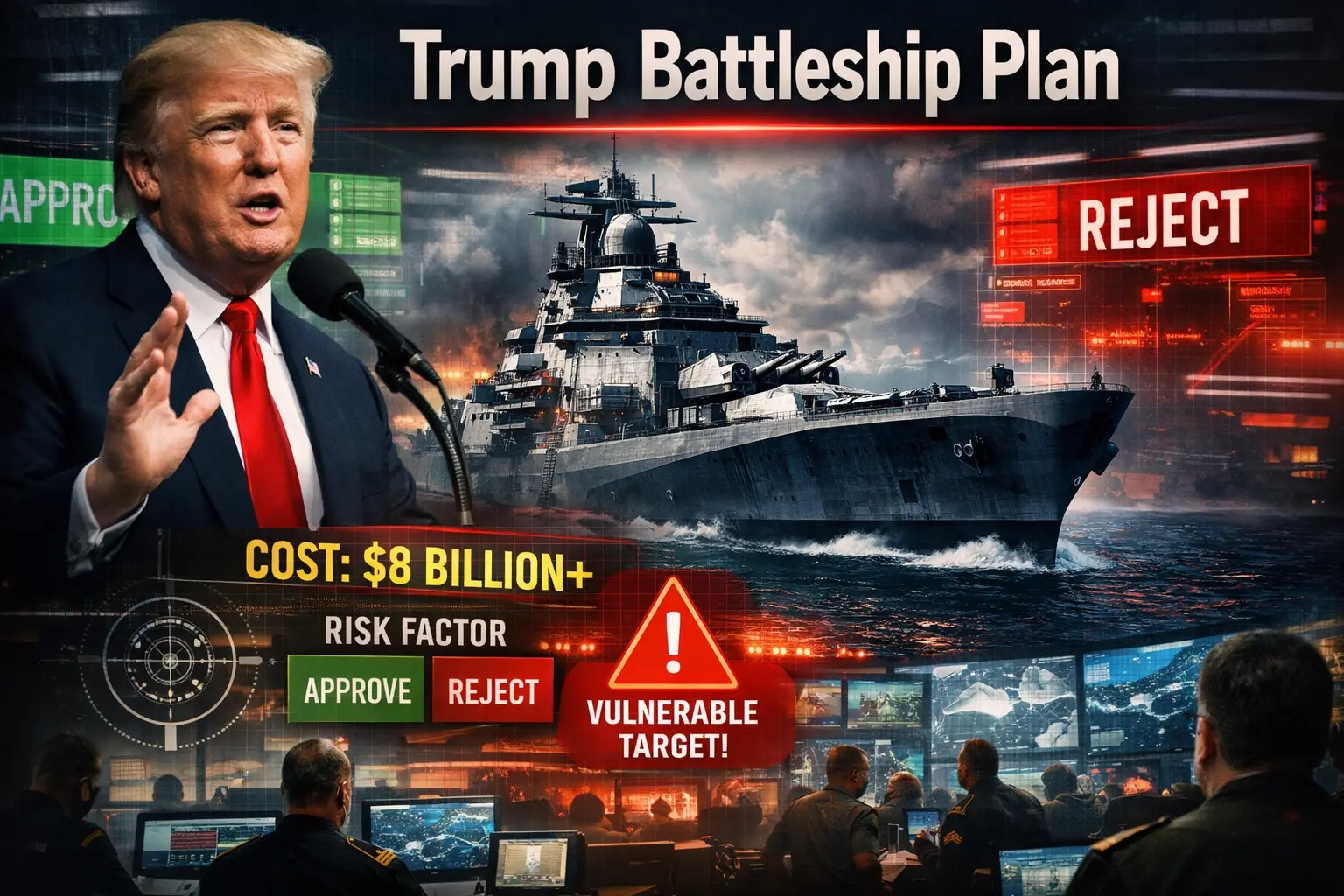
On Monday, President Donald Trump unveiled an ambitious — and highly controversial — plan: a brand-new “Trump-class” battleship. He promised it would be “the fastest, the biggest, and by far, 100 times more powerful than any battleship ever built,” calling it one of the “most lethal surface warfare ships” designed to secure U.S. military dominance and “strike fear” into America’s enemies.
But there’s one massive problem… battleships are relics of the past.
The U.S. hasn’t built a battleship in more than 80 years, and the last Iowa-class ships were retired nearly three decades ago. Once seen as ultimate power symbols, these giants were overtaken by aircraft carriers and missile-equipped destroyers long ago.
Even if the Navy isn’t literally reviving an old-school battleship design, defense analysts say Trump’s vision simply doesn’t line up with how modern naval warfare works.
Mark Cancian, a senior adviser at the Center for Strategic and International Studies, didn’t hold back, writing that “there is little need for said discussion because this ship will never sail.” He argued it would take too long to design, cost too much, and completely contradict the Navy’s strategy of spreading firepower across many smaller vessels instead of pouring it into a few giant ships.
“A future administration will cancel the program before the first ship hits the water,” Cancian predicted.
Bernard Loo, senior fellow at Singapore’s S. Rajaratnam School of International Studies, called the concept mostly “a prestige project.” He compared it to Japan’s legendary World War II super-battleships Yamato and Musashi — enormous, intimidating… and ultimately destroyed before they could change the war.
He warned the Trump-class’s massive size — over 35,000 tons and more than 840 feet long — would make it a prime target. “The size and the prestige value of it all make it an even more tempting target,” Loo said, bluntly labeling it a potential “bomb magnet.”
Bryan Clark, senior fellow at the Hudson Institute, suggested Trump may be drawn to the drama and symbolism of battleships, which dominated naval power for decades. The USS Missouri, the last U.S. battleship built, even hosted Japan’s surrender in 1945. The U.S. briefly brought four WWII battleships back in the 1980s to bulk up its fleet against the Soviet Union, an era Trump may view as peak American naval dominance.
Battleships last saw real combat in 1991 during the Gulf War, when Iowa-class ships fired Tomahawk missiles and provided heavy shore bombardment.
So, What Would This “Trump-Class” Ship Actually Be?
According to the Navy, the ship — part of a new “golden fleet” — would pack conventional guns, missiles, rail guns, lasers, and even the ability to carry nuclear and hypersonic weapons. In reality, experts say that sounds closer to a super-sized destroyer than a traditional battleship.
Still, Cancian argues it directly clashes with the Navy’s move toward distributed operations — relying on more ships with shared firepower instead of a few giant, vulnerable ones.
“This proposal would go in the other direction,” he wrote.
Then There’s the Price Tag… and It’s Huge
Even if it could be built, analysts say cost could kill the dream.
Loo pointed out that U.S. weapons programs already struggle with delays and budget overruns. The Zumwalt-class destroyers — now the Navy’s largest surface ships at 15,000 tons — were slashed from 32 to just three because of soaring costs. The newer Constellation-class frigate was also canceled due to design and workforce issues.
Clark estimated a Trump-class ship could cost two to three times more than a modern destroyer. With Arleigh Burke destroyers running about $2.7 billion each, that means one battleship could top $8 billion — before long-term staffing and maintenance costs.
And that, he said, would crush an already stretched Navy budget.
Loo went even further, calling it an outright bad strategy. “At the very least… It’s strategic hubris.”
If Trump pushes ahead, the idea may energize supporters who love bold military projects. But for now, experts across the defense world seem united on one thing: this is a spectacularly expensive gamble on a ship many believe should stay in the history books.