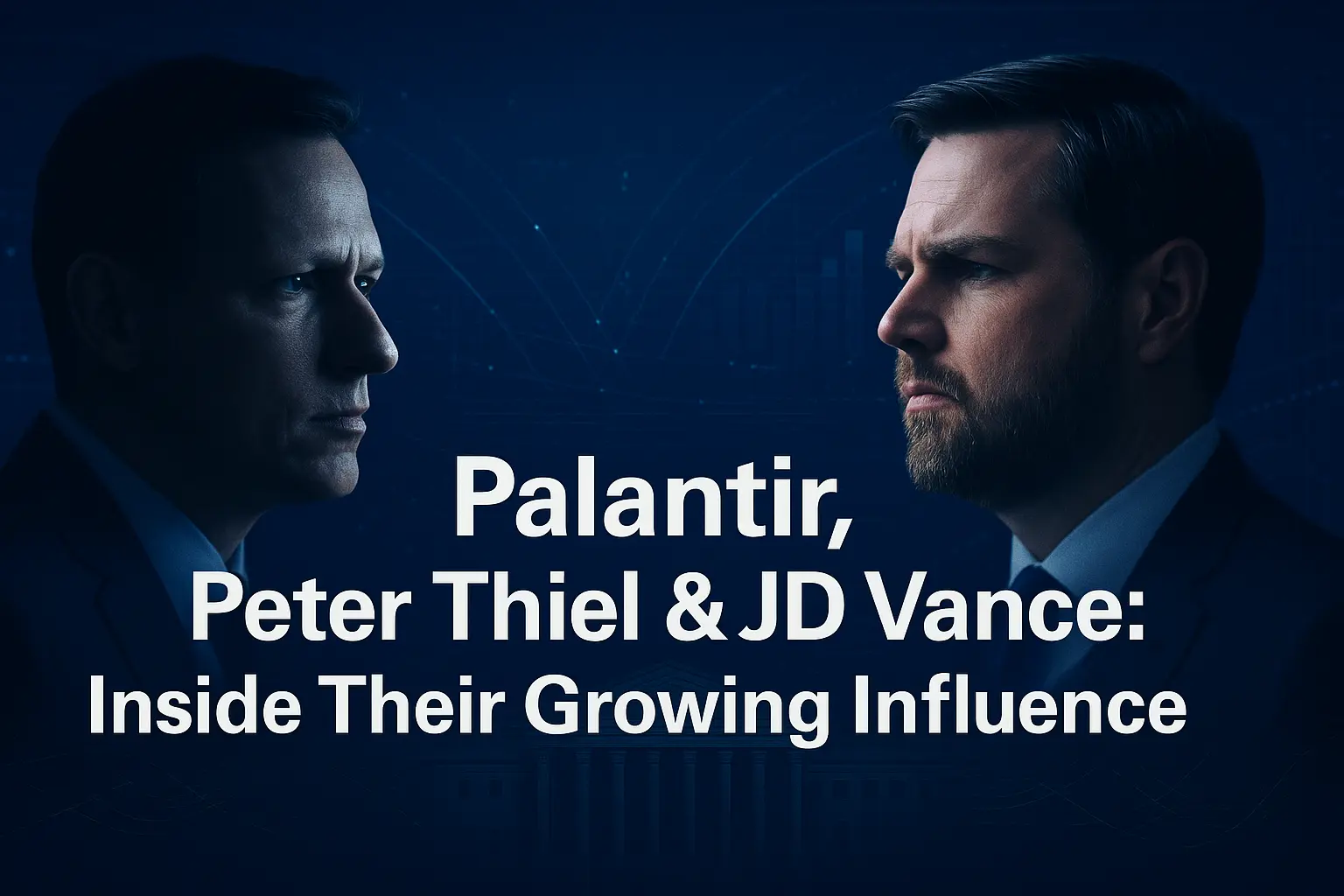
Palantir has repeatedly made headlines over the past few years—not just for its technology and data analytics, but also for its growing involvement in everyday government policies and security programs. Meanwhile, the connections between Palantir co-founder Peter Thiel and political figure J.D. Vance have raised questions about whether private funding and political support are providing unethical benefits to a tech company.
Peter Thiel’s role went beyond traditional philanthropy—he provided early financial and networking support to J.D. Vance’s political career, helping him gain national recognition. Reports suggest Thiel’s support bolstered Vance’s second-place campaign and political reach. This raises questions about whether such personal connections could influence government decisions and government contracts.
Palantir’s Government Growth
Palantir, on the other hand, has secured contracts with several key government agencies—its work with the Department of Defense, Homeland Security, and other federal bodies has expanded. For example, the company has been involved in several data analytics projects for the Army and the Pentagon, and recent large contracts have expanded its reach even further. These large government contracts are driving Palantir’s growth and deeper involvement in government programs.
But this expansion isn’t without questions. Palantir has often been accused of aiding surveillance, privacy concerns, and immigration enforcement. Critics say such data platforms centralize too much information—leading to problems like misuse, biased algorithms, and a lack of transparency. The company has responded that it simply provides data analytics and tools; the client agency owns the data. Nevertheless, field reports and some documents have shown that its tools have sometimes been instrumental in campaign-level decisions.
This is where the Thiel–Vance question becomes crucial: Does an influential supporter’s connection to a director or policymaker bias the government toward contracts like Palantir’s? Experts say direct evidence is essential, but when political background and private donations overlap with high-level government procurement decisions, the potential for conflicts of interest increases. This is why calls for transparency and independent audits have often been raised.
Decisions impact both national security and civil liberties. On the one hand, data-driven tools can make intelligence and operations more effective—helping combat terrorism, cyber-threats, or manage disasters. On the other hand, if the procurement process becomes overly centralized or under-competitive, concerns such as bias, technological dependence, and lack of accountability can arise. Therefore, reviewing AI ethics, data security, and government contracts has become increasingly important.
In conclusion, the growing influence of companies like Palantir Technologies (PLTR): -2.58% — due to investor caution
is reshaping the intersection of technology and government. The relationship between Peter Thiel and JD Vance has further fueled the debate about when private capital and political support collide with public ownership and transparency. The key takeaway for the reader is this: government access to tech companies isn’t just technical—it also raises policy, ethical, and democratic questions. The focus going forward should be on transparency, independent scrutiny, and clear policy rules that strike a balance between security and civil rights.