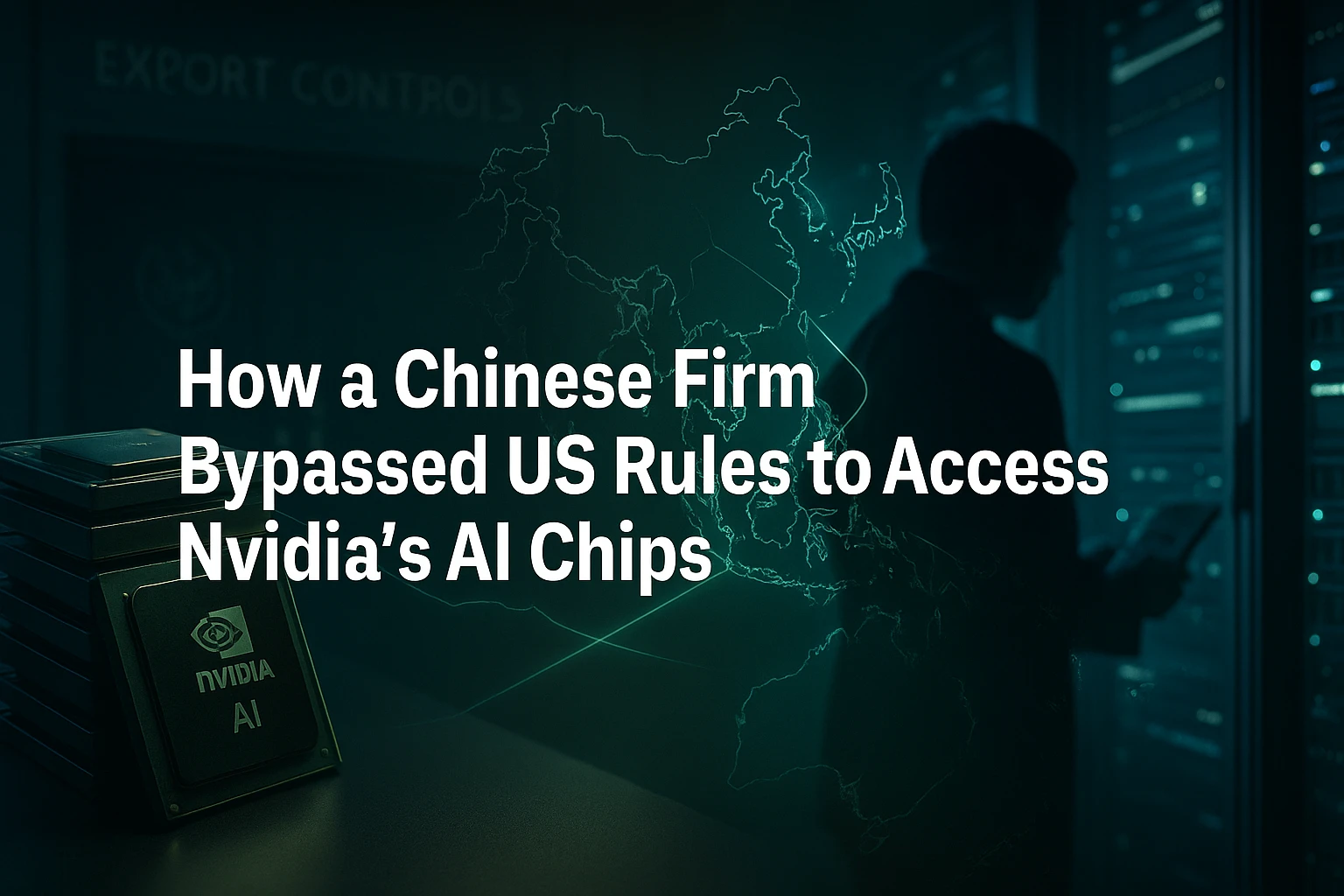
Demand for AI has grown so rapidly in recent years that companies worldwide are clamoring for high-performance GPU chips. The US has restricted the export of some advanced Nvidia chips to China for security reasons—to prevent sensitive military and intelligence use. Recent cases show that some Chinese AI companies have exploited loopholes in these regulations to gain access to advanced GPUs.
In the most high-profile example, US and journalist investigations revealed that the transaction chain was so complex that the chips ultimately didn’t even need to be physically in China—they were stored in data centers in third countries and used remotely. One detailed report revealed that some chips were transported to a data center in Indonesia, which then served Chinese clients. This setup challenged the bounds of traditional “direct export from one country” rules.
US officials say some Chinese firms used middlemen and subsidiaries in places like Singapore or Indonesia to gain access to powerful Nvidia GPUs like the H100—and in doing so, undermined the spirit of the rules. But note: in many cases, it wasn’t clearly proven that the rules were legally broken; in most cases, it was a “gray zone”—a question of the letter of the law versus the intended use.
It’s important to understand why these chips are important: Nvidia’s H-series and their equivalent GPUs have become the standard for training modern large-scale AI models. Therefore, companies with these resources are able to rapidly train models and advance research. This also creates competition in the market for them, and some firms pursue alternative routes, such as cloud-based GPU hosting, rented-out time, or third-country data centers.
Rule Compliance vs. Loopholes
Is this “wrong”? Each case is different. Some reports suggest that companies have entered into binding agreements that manage the ownership or physical location of chips in such a way that it is difficult to find evidence of direct violations of US regulations. Meanwhile, US officials and some experts say these drivers circumvent the spirit of the rules—posing a security risk. Therefore, governments and agencies are considering tightening regulations and increasing oversight of third-country routes.
Companies and manufacturers also have a say: Firms like Nvidia say they comply with regulations and emphasize transparency of customer research. Some major players are also seeking a balance between market and policy pressures by providing chip designs or “degraded” versions—modified versions of certain models for specific markets.
What’s next? Global Artificial intelligence competition will intensify, and chip policies will play a crucial role. Efforts to circumvent US-imposed controls, stricter oversight of third-country routes, and new regulations on cloud technologies are all likely. Meanwhile, China-based companies may shift their strategies—either accelerating domestic semiconductor development or pursuing more sophisticated overseas routes.
In short:
Recent events indicate that, despite technical restrictions, companies seeking access to cutting-edge Nvidia-type GPU resources are finding new ways. This is not only a question of trade, but also of national security, global AI competition, and policymaking. Readers—like you—who are involved in the world of Artificial intelligence and technology should keep an eye on these policy changes and market trends, as these factors will determine which economies will reap the benefits of AI and what kind of global competition will unfold in the coming years.
Disclaimer: This article is based on publicly available reports, investigations, and analyses from credible news sources. It does not claim or allege any illegal activity unless officially confirmed by authorities. The information is intended for educational and informational purposes only.