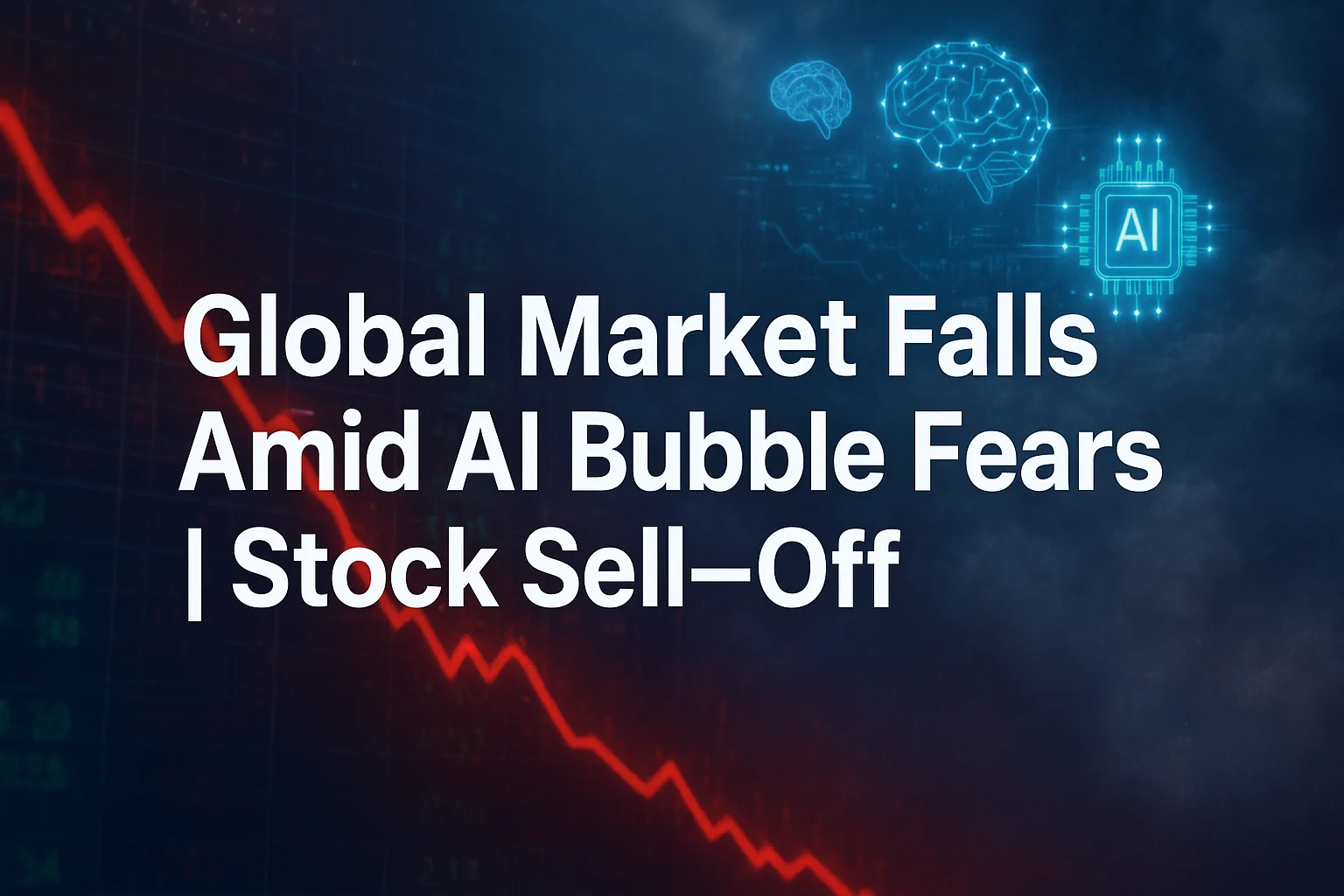
Over the past few months, the sector that has attracted the most attention from investors worldwide is AI (Artificial Intelligence). Companies are continuously increasing their investments in this technology, and market demand for it has grown rapidly. But now, this rapid growth has given rise to a new fear—could this be the beginning of the AI bubble bursting?
This concern has led to a major sell-off in global markets in recent days, affecting everything from European stock markets to Asian chipmakers.
European markets experienced sharp declines on Tuesday, with shares of tech and semiconductor companies under the most pressure. Major indices in London, Frankfurt, and Paris fell by 1 to 1.5 percent. Analysts believe this downturn is not limited to Europe, but is part of a broader global stock sell-off, driven by fears that valuations of companies in the AI sector have become excessively high.
Meanwhile, the situation for chipmakers in Asia worsened. Japan’s Nikkei 225 fell by nearly 2 percent, while shares of major companies like South Korea’s Samsung Electronics and SK Hynix experienced sharp declines. Shares of Taiwan’s TSMC also dropped, despite the company being a leading name in the field of AI chip manufacturing.
These declines clearly showed that investor confidence has weakened and the market has entered a risk-off mode.
According to financial analysts, many investors made significant profits in AI stocks during the recent rally, but they are now starting to book those profits. This has created downward pressure in the short term. Some experts also suggest that investors have become more cautious about the actual growth and earnings potential of the Artificial Intelligence sector.
Several reports indicate that the valuations of some Artificial Intelligence companies have now risen significantly above traditional benchmarks, increasing fears of an “AI bubble.”
On the other hand, it’s also true that this downturn is not limited to the AI sector alone. Global market sentiment has weakened in both Europe and Asia. Rising interest rates, slower economic growth in China and Europe, and geopolitical tensions (such as the situation in the Middle East) have all contributed to market instability.
American investors are also closely watching this trend, as US tech companies like Nvidia, Microsoft, and Alphabet (Google) are at the heart of this entire AI investment wave. Some of their shares closed slightly lower in recent sessions, while Nasdaq futures also showed weakness.
However, some experts believe this decline is a “healthy correction” rather than the beginning of a real crisis. They say that shares of Artificial Intelligence-related companies had risen so rapidly in the past few months that even a small negative signal could trigger a sell-off.
The long-term prospects for AI remain strong-the application of Artificial Intelligence in sectors such as healthcare, finance, energy, and technology will yield real benefits in the coming years. However, the short term remains risky for investors.
This is an important lesson for investors: don’t invest in emerging technologies solely on hype. While the Artificial Intelligence revolution may be changing the world, every new wave is followed by a valuation correction. Investors must maintain a balanced portfolio and stick to a long-term strategy.
In conclusion, it’s fair to say that companies involved in Artificial Intelligence have a bright future, but currently, the market is in a situation where expectations have outpaced reality. If companies’ results and earnings don’t meet expectations in the coming weeks, we could see further volatility in the global market.
However, if corporate earnings improve and economic stability persists, this decline could also prove to be an opportunity for investors in the long run.
The main thing:
The Artificial Intelligence sector remains a hub of innovation today, but investors must now understand that every boom is followed by a period of stagnation.
This market downturn is perhaps not a sign of fear, but rather an opportunity for rebalancing—so that future growth can be more sustainable and realistic.