In December, the Fed announced a cut in the policy rate, but this doesn’t always translate directly into an equivalent reduction in mortgage rates. In the real world, average rates for 30-year fixed mortgages still depend on market supply and demand, bank pricing, and conditions in the securities market—and according to recent reports, the national average 30-year fixed rate is currently hovering around 6.22%.
To put it simply: the Fed funds rate and mortgage rates are not the same. The Fed’s policy cuts send a signal to the market that interest rate pressure may ease, but rates on the lending side don’t necessarily fall immediately—so borrowers don’t always see a direct and quick benefit. Many experts are also saying that mortgage rates haven’t fallen significantly; the decline has been limited.
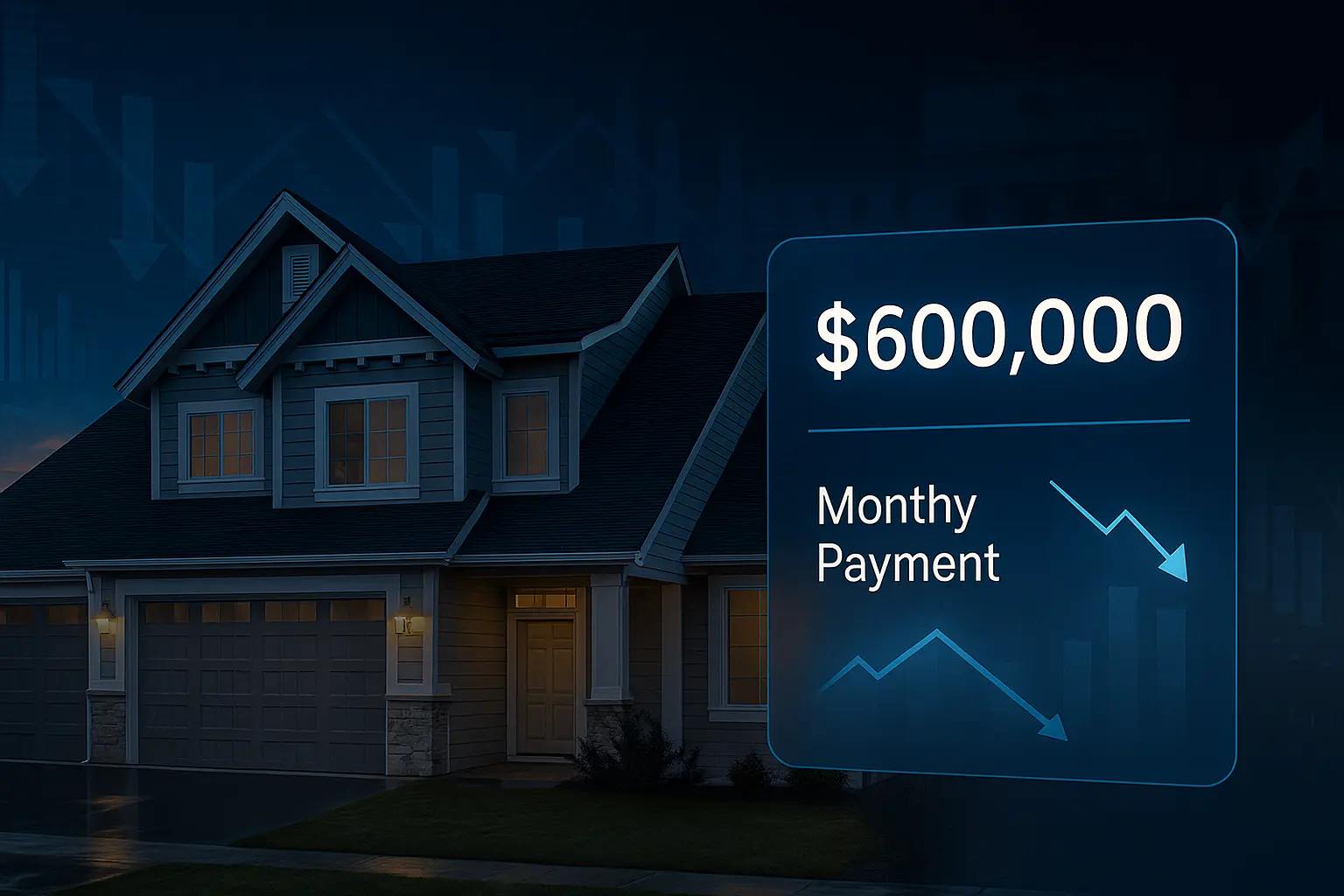
Now let’s get straight to the calculations—let’s assume you’re taking out a $600,000 30-year fixed mortgage. A comparison of two estimated rates is shown below (a conservative “previous” rate and a current average):
- Previous example (e.g.) — 7.00% annual interest rate (assuming a historically high rate).
- Current average (according to Freddie Mac’s weekly data) — 6.22% (weekly average as of 12/11/2025).
Monthly payment (30 years, 360 months) — calculation (principal and interest):
- Monthly payment at 7.00% ≈ $3,991.81.
- Monthly payment at 6.22% ≈ $3,682.60.
This means: if your rate drops from 7.00% to 6.22%, your monthly savings would be approximately $309.21, and your annual savings would be approximately $3,710.53. Over 30 years, these savings could add up to roughly $111,315—a significant difference in your total interest costs. (These figures are for principal and interest only; taxes, insurance, HOA fees, etc., are separate.)
Why does this difference matter? A small difference in the annual interest rate compounds over months and has a significant impact on the total cost of a long-term home loan (mortgage). For example, the total interest paid over 30 years at the rates mentioned above differs considerably—the total interest at 7% is significantly higher than at 6.22%. This is where refinancing comes in: if you already have a loan and the new rate is sufficiently lower, refinancing can reduce both your monthly payments and the total interest paid. However, refinancing involves its own closing costs, so you should always calculate the break-even point (how many months it will take to recoup the costs).
How to move forward (practical tips):
- Check your credit score and DTI (debt-to-income) ratio — a better score leads to better mortgage pricing.
- If you’re already a borrower, include closing costs, performance fees, and the break-even period in your refinance calculations.
- Get pre-approved by multiple lenders; compare several loan offers on the same day, as rates and points can vary.
- If you plan to sell your home in the short term (2–5 years), refinancing might not be worthwhile; a cost-benefit analysis is essential beforehand.
In conclusion—a simple takeaway: Average 30-year mortgage rates have edged down slightly since the Fed’s December rate cut, but haven’t fallen dramatically; for example, Freddie Mac reported a weekly average of approximately 6.22%. At this rate, the monthly payment on a $600,000 30-year loan is about $3,682.60, which is somewhat better than at previous higher rates and results in annual and long-term savings.